Xie Xiang, Lv Wenzhen, Chen Runfeng, Huang Wei. Micro/Nano Structure Regulation of Donor/Acceptor Interface for High-Performance Organic Solar Cells[J]. Progress in Chemistry, 2016, 28(11): 1591-1600.
Contents
1 Introduction
2 Effects of micro/nano structures on photovoltaic properties
3 Methods to construct micro/nano interface structures
3.1 Nanoimprint lithography
3.2 Self-assembly technology
3.3 Solvent evaporation
3.4 Template methods
4 Applications of micro/nano structures on solar cells
4.1 Nano-textured interface
4.2 Nano gratings structure
4.3 Nanorods arrays
4.4 Nanoparticles
4.5 Rough interface
4.6 Special patterns
5 Conclusions and perspectives

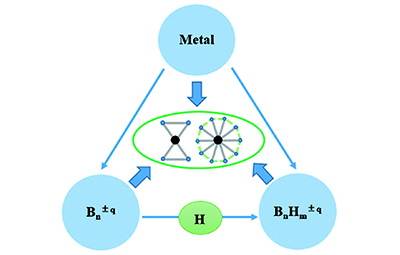
Shen Yanfang, Xu Chang, Huang Min, Wang Haiyan, Cheng Longjiu. Research Advances of Boron Clusters, Borane and Metal-Doped Boron Compounds[J]. Progress in Chemistry, 2016, 28(11): 1601-1614.
Contents
1 Introduction
2 Pure-boron clusters
2.1 Neutral boron clusters
2.2 Anionic boron clusters
2.3 Cationic boron clusters
3 Borane clusters
3.1 Anionic borane clusters
3.2 Neutral borane clusters
3.3 Cationic borane clusters
4 Metal-doped boron clusters
4.1 Metal-doped all-boron clusters
4.2 Metal-doped borane compounds
4.3 Transition-metal sandwich-type complexes
4.4 Metal-centered boron molecular wheels
5 Conclusion
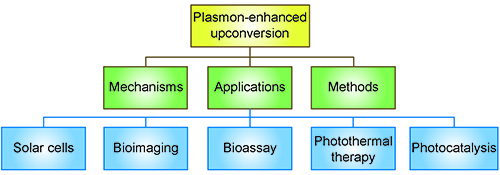
Zhao Bing, Qi Ning, Zhang Keqin. Plasmon-Enhanced Upconversion Fluorescence and Its Application[J]. Progress in Chemistry, 2016, 28(11): 1615-1625.
Contents
1 Introduction
2 Mechanisms
2.1 Plasmon-enhanced excitation
2.2 Plasmon-enhanced emission
2.3 Energy transfer
3 Methods
3.1 Chemical methods
3.2 Physical methods
4 Applications
4.1 Solar cells
4.2 Bioimaging
4.3 Bioassay
4.4 Photothermal therapy
4.5 Photocatalysis
5 Conclusion
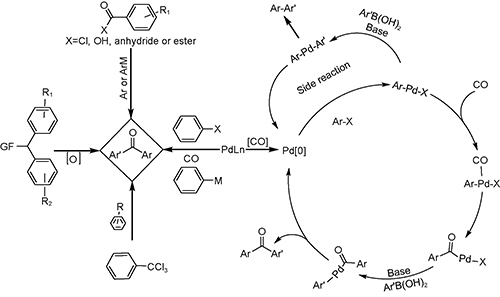
Zhu Zhuangli, Zhang Weiqiang, Gao Ziwei. Suzuki-Miyaura Carbonylative Reaction in the Synthesis of Biaryl Ketones[J]. Progress in Chemistry, 2016, 28(11): 1626-1633.
Contents
1 Introduction
2 Pd catalyzed Suzuki carbonylation
2.1 Homogeneous Suzuki carbonylation
2.2 Heterogeneous Suzuki carbonylation
3 Transmetalation of Suzuki carbonylation
4 New carbonyl source of Suzuki carbonylation
5 Examples
6 Prospect of Suzuki carbonylation
Zhang Yongjie, Li Huayi, Qu Minjie, Feng Na, Yang Wei, Zhang Chong. Well-Defined Polyolefin Graft Copolymers: Syntheses, Structures, and Properties[J]. Progress in Chemistry, 2016, 28(11): 1634-1647.
Contents
1 Introduction
2 Graft-through method
2.1 Polyolefin as backbone
2.2 Polyolefin as graft chain
3 Graft-from method
3.1 Borane Approach
3.2 Tolyl Group
3.3 (hydrochlorinated) Vinylphenyl group
3.4 Hydroxyl
3.5 Inimer
3.6 Non-olefin-coordination-polymerization approach
4 Graft-onto method
5 Conclusion

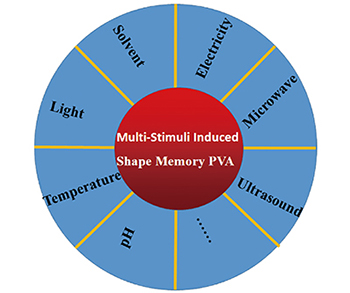
Du Haiyan, Lei Xia, Xu Yuyu, Liang Zhenhai, Wang Yonghong. Multi-Stimuli Induced Shape Memory Effect of Polymers Based on Poly(vinyl alcohol)[J]. Progress in Chemistry, 2016, 28(11): 1648-1657.
Contents
1 Introduction
2 Multi-stimuli induced shape memory polymers based on PVA
2.1 Temperature induced shape memory gel and polymer
2.2 Light induced shape fix of PVA derivative
2.3 Solvent induced shape memory PVA and composites
2.4 Electroactive shape memory PVA composites
2.5 Ultrasound-triggered shape memory PVA
2.6 Microwave induced shape memory PVA and composites
3 Conclusion
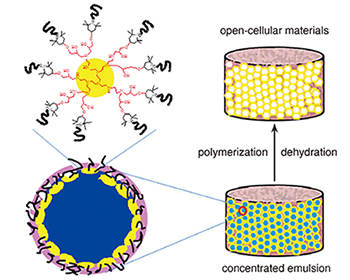
Feng Yanyan, Jin Ming, Wan Decheng. A Bridge Spanning Microscopic to Macroscopic Assembly: Application of the Technique of Polymerization of Concentrated Emulsion[J]. Progress in Chemistry, 2016, 28(11): 1658-1663.
Contents
1 Introduction
2 Direct surface functionalization of polyHIPE
3 Direct preparation of metal nanoparticle-decorated polyHIPE
4 Conclusion
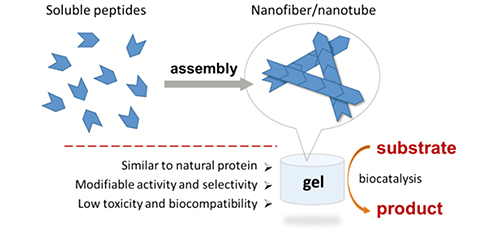
Zhao Yanan, Wang Mengfan, Qi Wei, Su Rongxin, He Zhimin. Supramolecular Artificial Enzyme Based on Assembling Peptide Gel[J]. Progress in Chemistry, 2016, 28(11): 1664-1671.
Contents
1 Introduction
2 Reaction types catalyzed by peptide-based artificial enzyme
2.1 Hydrolysis reaction
2.2 Aldol reaction
2.3 Redox reaction
3 Influence factors on the activity of peptide-based artificial enzyme
3.1 Assembly degree
3.2 Microstructure
3.3 Supramolecular structrue
3.4 Active-site microenvironment
3.5 pH
4 Application of peptide-based artificial enzyme
5 Conclusion
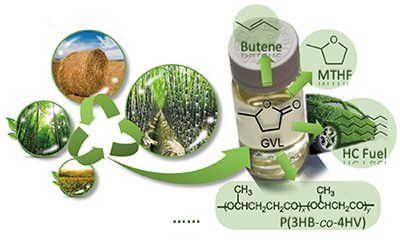
Wei Junnan, Tang Xing, Sun Yong, Zeng Xianhai, Lin Lu. Applications of Novel Biomass-Derived Platform Molecule γ-Valerolactone[J]. Progress in Chemistry, 2016, 28(11): 1672-1681.
Contents
1 Introduction
2 Employing GVL as a green solvent
3 Synthesis of carbon-based chemicals from GVL
4 Synthesis of polymeric materials from GVL
5 Synthesis of liquid hydrocarbon fuels from GVL
6 Conclusion
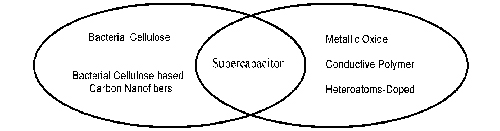
Xia Wen, Li Zheng, Xu Yinli, Zhuang Xupin, Jia Shiru, Zhang Jianfei. Bacterial Cellulose Based Electrode Material for Supercapacitors[J]. Progress in Chemistry, 2016, 28(11): 1682-1688.
Contents
1 Introduction
2 BC and BC based carbon nanofiber electrode material for supercapacitors
2.1 BC based flexible electrical double-layer capacitive supercapacitor
2.2 BC based pseudo-capacitive supercapacitor
3 Conclusion
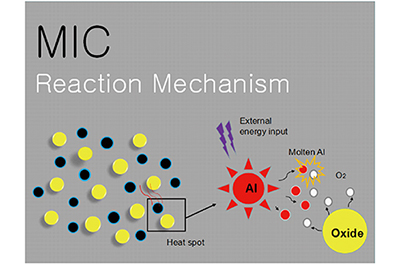
Wang Yajun, Li Zexue, Yu Haiyang, Feng Changgen. Reaction Mechanism of Metastable Intermolecular Composite[J]. Progress in Chemistry, 2016, 28(11): 1689-1704.
Contents
1 Introduction
2 Experimental research
2.1 Partical size
2.2 Loading density
2.3 Content of reactive Al
2.4 Al/oxide ratio
2.5 Microstructure
2.6 Preparation method
2.7 Properties of oxidizer
2.8 Role of oxygen[O]
2.9 Microscale charge
2.10 Ignition mechanism
2.11 Others
3 Numerical simulation research
3.1 Molecular dynamics simulation
3.2 Thermal diffusion simulation
3.3 Output pressure simulation
3.4 Rapid oxidation simulation
3.5 Fluid dynamics simulation
3.6 Detonation simulation
4 Theoretical model research
4.1 Diffusion oxidation mechanism
4.2 Ion diffusion mechanism
4.3 Polymorphic phase change oxidation mechanism
4.4 Melt-dispersion mechanism
4.5 Metal-oxygen flip mechanism
4.6 Convective combustion mechanism
4.7 Modified Cabrera-Mott model
4.8 Pre-ignition sintering mechanism
5 Reaction mechanism of modified MIC
6 Conclusion
Xing Liwen, Ma Zhanfang. Non-Enzymatic Electrochemical Sensors Based on Carbon Nanomaterials for Simultaneous Detection of Ascorbic Acid, Dopamine, and Uric Acid[J]. Progress in Chemistry, 2016, 28(11): 1705-1711.
Contents
1 Introduction
2 Carbon nanomaterials-based non-enzymatic electrochemical sensors for simultaneous detection of ascorbic acid, dopamine, and uric acid
2.1 One-dimensional carbon nanomaterials
2.2 Two-dimensional carbon nanomaterials
2.3 Zero-dimensional carbon nanomaterials
2.4 Three-dimensional carbon nanomaterials
3 Conclusion
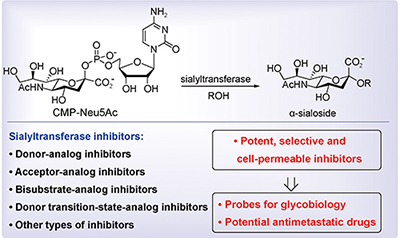
Guo Jian, He Yun, Ye Xin-Shan. Design and Discovery of Sialyltransferase Inhibitors[J]. Progress in Chemistry, 2016, 28(11): 1712-1720.
Contents
1 Introduction
2 Relationship between sialic acids and cancers
3 Design and discovery of sialyltransferase inhibitors
3.1 Donor-analog inhibitors
3.2 Acceptor-analog inhibitors
3.3 Bisubstrate-analog inhibitors
3.4 Transition-state-analog of the sialyl donor inhibitors
3.5 Other types of inhibitors
4 Conclusion