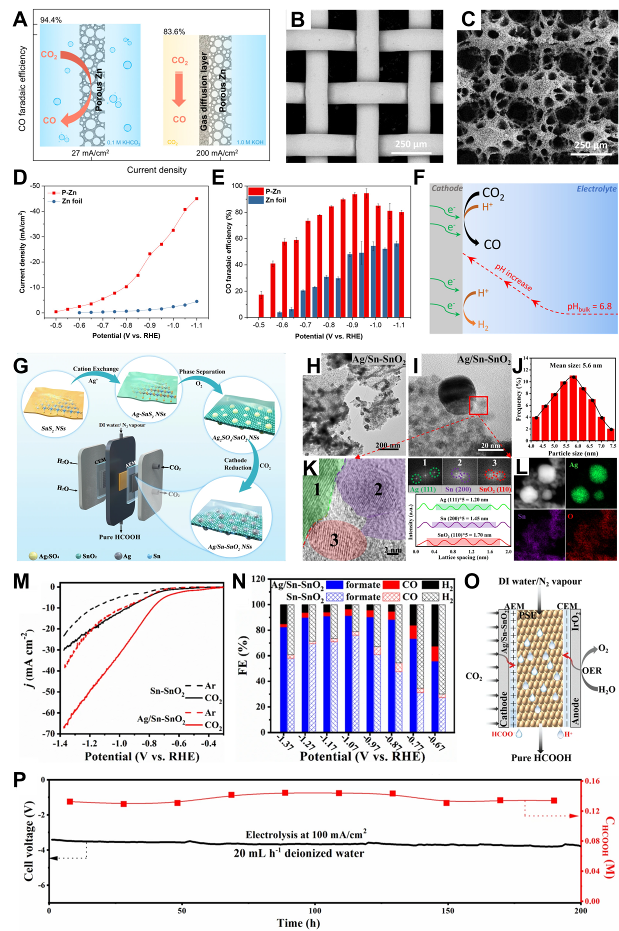
Fig. 2 Electrode configurations of Zn, Ag, and Sn-based materials: (A) Porous Zn electrode can convert CO2 to CO at -0.95 V (relative to the RHE electrode) with high FE (∼95%) and current density (27 mA cm−2). (B) SEM images of Cu lattice and (C) P-Zn. (D) Potential-dependent current densities of P-Zn and Zn foils. (E) FE of CO. (F) Schematic representation of the local pH effect in CO2RR[4]. (G) Schematic representation of the synthesis process of Ag/Sn-SnO2 nanosheets electrocatalyzing the conversion of CO2 to pure HCOOH solution. (H, I) Typical TEM images of Ag/Sn-SnO2 NSs. (J) Particle size distribution of Sn-SnO2 in Ag/Sn-SnO2 NSs. (K) Particle size distribution of Ag/HRTEM images and corresponding FFT maps of Sn-SnO2 NSs with integrated pixel intensities of Ag, Sn, and SnO2. (L) HAADF-STEM images and EDX mapping images of Ag/Sn-SnO2 NSs. (M) Electrocatalytic LSV curves. (N) FEs of formate CO and H2. (O) Reduction of CO2 in PSE cell to pure HCOOH with accompanying OER reaction. (P) Concentration of HCOOH under deionized water as a diffusion carrier, and the FE of the corresponding HCOOH[18]
Other figure/table from this article