


1 生命体系中聚糖的结构、功能与合成
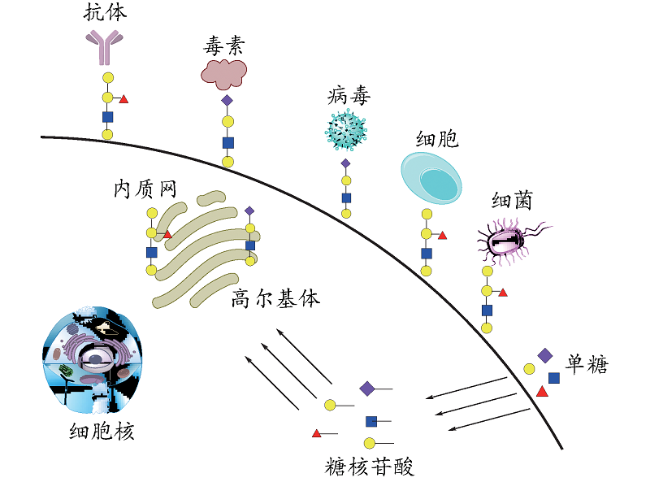
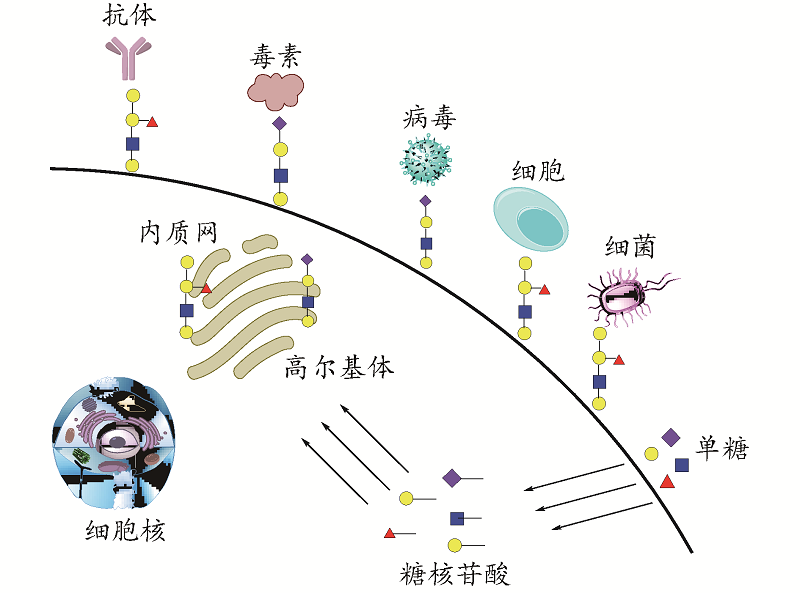
聚糖是以单糖作为基本单元,以糖苷键相连形成的线性或者分枝状的聚合分子。其中既有个头最小、结构简单的二糖,如蔗糖、麦芽糖和乳糖等;也有结构较为复杂但不超过20个单糖组成的寡糖;更有数量庞大的天然多糖。单糖单元、糖苷键立体化学或连接位置的细微变化即会引起聚糖的理化性质和功能的显著变化。例如,直链淀粉和纤维素都是由(1→4)链接的葡萄糖作为重复单元的葡聚糖,其唯一区别在于糖苷键的立体化学。直链淀粉通过α葡萄糖苷键相连接,其较为弯曲的α型糖苷键有利于螺旋结构的形成;纤维素则由β葡萄糖苷键相连接,易于形成伸展的结构。这一微小的糖苷键立体化学差异不仅造成了明确的理化性质差异,如水溶性,也展示了完全不同的生物学功能。直链淀粉用于储存从光合作用过程中获得的化学能;而纤维素则作为植物的结构材料。而其他不同连接形式(如1→3和1→6连接)和支化的β-葡聚糖广泛存在于细菌、藻类、真菌和谷类植物中,具有多样的生物学功能和药用活性[3]。例如,肠道共生菌双歧杆菌中的β-葡聚糖能够诱导调节免疫细胞的产生,较好地抑制结肠炎[4];口服β-葡聚糖能增加胰岛素的分泌,稳定血糖水平以实现对糖尿病的控制[5]等。
2 聚糖化学合成的挑战与进展
相比于核酸和蛋白质,聚糖在诸多生命过程中的作用依然未被揭开面纱,这与其独特而复杂的分子结构密切相关。核酸和蛋白质是分别通过磷酸二酯键和酰胺键相连的线性分子,而聚糖化合物是通过糖苷键相连,具有α、β两种立体构型,而且单糖是多羟基的醛或者酮类化合物,可以形成分支结构。另外,组成聚糖的基本单元——单糖,在自然界中存在有上百种。而且,聚糖结构中大量的羟基还存在不同的修饰方式,如乙酰化、甲基化、磷酸化和硫酸化等。蛋白质和核酸的自动测序、自动合成和基因表达等技术的发明与应用,极大地加速了基因组学和蛋白质组学的研究进程,而聚糖研究中,糖链的自动合成仪目前仅能应用于一些结构简单聚糖的合成[6]。
具有精确结构的聚糖的化学合成仍然是一个尚未解决的挑战,其中的主要原因包括:难以控制活性相似的多个羟基的区域选择性;难以控制糖苷键的立体化学;难以获得高分子量的聚糖。目前有三种方法来合成高分子量的聚糖:(1)逐步糖苷化;(2)缩聚反应;(3)开环聚合[7]。缩聚反应和开环聚合只能合成聚糖混合物;逐步糖苷化反应可以合成结构确定的聚糖,但是合成效率很低,也只有少数类型的聚糖能够被合成。为了精准合成聚糖,化学家们发展了大量的正交保护基、糖苷化方法和合成策略。正交保护策略用于选择性地屏蔽糖环上的羟基,只保留特定位点的羟基用于后续糖苷化反应,但是所需的具有正交保护基的糖砌块的制备过程费时费力。另一方面,立体选择性地控制糖苷键的形成也是一个极大的挑战,尽管选择性糖苷化的反应被大量研究,但是这些方法的普适性仍然不理想[8]。在过去的几十年里,大量新的糖苷化方法(包括糖基给体和促进剂)被报道[9],糖化学家也开始了合成天然或非天然多糖的相关研究。目前来说,通过化学全合成结构明确的聚糖的分子量通常小于10 000 g/mol(聚合度小于60),合成更长、更大的聚糖仍是十分困难的[7]。
3 聚糖化学合成中的一些不确定因素
3.1 溶剂效应
溶剂作为糖苷化反应体系中最大量的物质,对反应有着不可忽视的影响。糖基给体在促进剂活化条件下,离去基团解离后形成的氧鎓离子中间体与溶剂之间可能存在相互作用。因此,按照溶剂的极性和提供孤对电子的能力可以分为:(1)低极性弱配位的溶剂,如苯和甲苯;(2)中等极性弱配位的溶剂,如二氯甲烷、硝基甲烷和1,2-二氯乙烷等,是最常使用的反应溶剂,即使在低温下对有机底物的溶解度也极好,且不会引起副反应;(3)高极性强配位的溶剂,如乙腈和丙腈等,它们是溶剂化效应较强的一类溶剂,可以与糖基氧鎓中间体形成正离子络合物,显著影响糖苷化反应的立体选择性[12];(4)低极性强配位的溶剂,如乙醚、二氧六环和四氢呋喃。与高极性的溶剂不同,尽管它们有强的配位能力,但是对离子的解离能力很低,在这类溶剂中离子对的稳定性比在腈类中更高;当它们作为糖苷化的溶剂时,也会显著提高糖苷化反应的选择性。
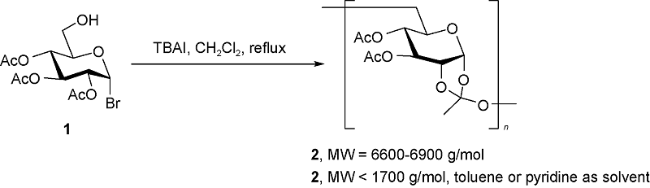
在聚糖缩聚合成中,反应是逐步增长的过程,缩聚产物实现高分子量只有在转化率达到90%以上才有可能达到,转化率90%时的理论聚合度只有10,转化率99%时的理论聚合度可达到100[13]。Du课题组[14]在利用2,3,4-三乙酰基葡萄糖溴苷进行缩聚反应制备多糖类聚原酸酯时,采用二氯甲烷作为溶剂,四丁基碘化铵作为促进剂,回流条件下,制备得到的聚糖分子量达到6600~6900 g/mol(图2 );但是,将溶剂换成苯、甲苯和吡啶时,聚糖的分子量都小于1700 g/mol。 由于原酸酯结构对酸解的高敏感性,此类聚糖可能用于合成对pH高度响应的材料,这种材料可以快速、选择性地将药物输送到细胞外pH值较低的恶性组织。
3.2 浓度效应
3.3 温度效应
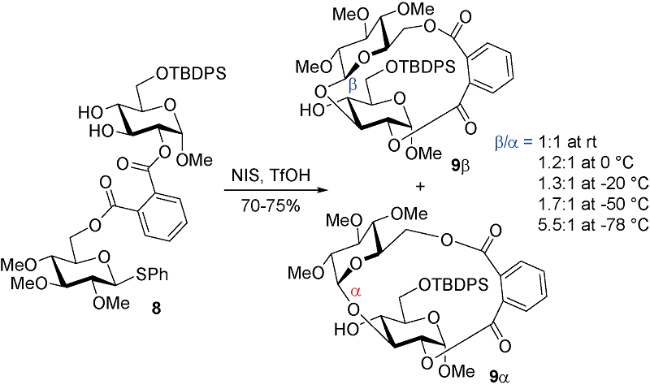
反应温度对糖苷化反应产率、立体选择性和聚合度有非常重要的影响[20]。一般来说,温度越高,反应物的溶解度会增加,试剂的反应性会增强。西班牙的Valverde课题组[21]在进行模板导向环状糖苷合成时发现,温度对产物的立体构型有很大的影响(图4 )。在进行二糖分子内糖苷化时,室温条件下,环状二糖产物的生成没有立体选择性(β/α = 1∶1);当温度降低后,β选择性会显现,-50 ℃时,选择性稍有改善(β/α = 1.7∶1);当温度降低到-78 ℃,β选择性提高到5.5∶1。纽约州立大学的Sharkey等在进行1,2-环氧开环糖苷化合成聚糖时也发现类似现象。在高温条件下,利用五氟化磷等路易斯酸作为引发剂进行的开环聚合反应的立体选择性较差,容易形成可观数量的异构体。在低温条件下,聚合主要通过三烷基氧鎓机理进行,得到1,2-反式构型聚糖;而在高温条件下,氧鎓中间体占主导,容易形成热力学稳定的α构型聚糖。以3,4,6-O-三苄基-1,2-环氧葡萄糖为例,在五氟化磷引发条件下,-60 ℃反应4 h,分子量可以达到10000 g/mol,β-(1→2)糖苷键占比达到90%,α糖苷键占比10%[22]。升高温度或者改变促进剂,聚合度和立体选择性都会降低。
3.4 非均相反应中的问题
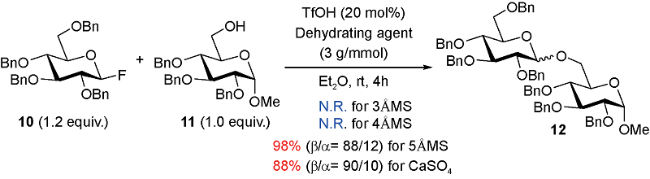
糖苷化反应中一般需要加入干燥剂,以除去溶剂和反应物中所含有的微量水分,因此,反应体系变成非均相。东京理科大学的Mukaiyama课题组[23]发现,同一个糖苷化反应加入不同干燥剂呈现不同的效果(图5 )。加入3 Å或4 Å分子筛,糖苷化反应未能进行;而加入5 Å分子筛,糖苷化反应却可以顺利进行,以98%的产率得到所需二糖(α/β = 88/12);加入硫酸钙作为干燥剂,糖苷化产率稍有降低(88%,α/β = 90/10)。北海道大学的Kakuchi课题组[24]在研究1,6-脱氧甘露糖的开环聚合反应时发现,加入六氟锑酸2-丁烯四氢噻吩鎓盐作为引发剂,聚合反应前5 min是均相反应,之后逐渐转变成非均相反应,形成非凝胶状高度分支的甘聚糖。
3.5 溶解度的问题
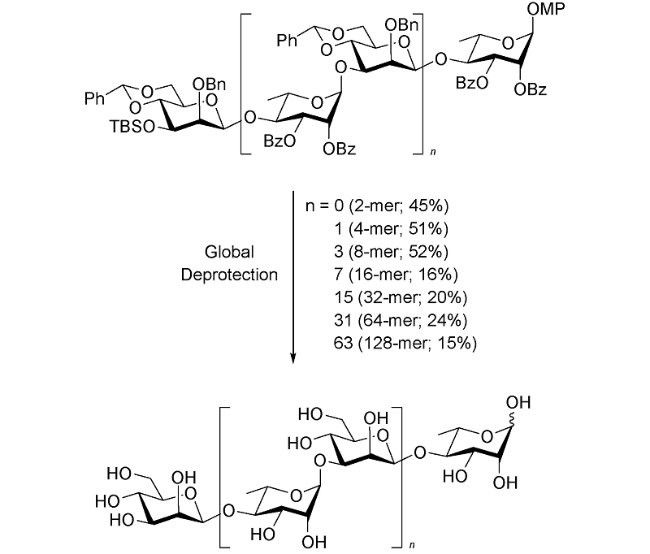
近年来,利用逐步合成方法制备精确结构的、大于20个单糖的聚糖有所报道[25],其中,糖链保护基的脱除是一大难点。聚糖合成涉及大量的保护基,它们的完全脱除需要较为剧烈的反应条件和较长的反应时间。保护基部分脱除后的反应中间体或者保护基完全脱除后的最终产物在溶液体系中有很大的溶解度变化,由于弱相互作用力的改变而发生聚集现象。聚集体可能从溶液中析出,影响反应的进程。纤维素类葡聚糖的稳定性、结晶度和较差的水溶性是由其密集的分子间和分子内氢键网络和疏水作用等所导致,包括其相邻葡萄糖残基的3位羟基与5位羟基的氧原子之间氢键;糖环6位羟基和2位羟基的分子内和分子间氢键;富含C-H键的糖环极性表面之间的疏水相互作用以及范德华力。德国马普胶体与界面研究所Seeberger和Delbianco团队[26]合成了一系列纤维素及其衍生物,发现聚糖的保护基脱除产率与其糖链长度、修饰方式和官能化程度相关。 例如,纤维六糖和十二糖在保护基脱除时,发生溶液体系中的聚集效应和中间体的溶解度变化;纤维六糖保护基脱除的产率是18%,而纤维十二糖的脱除产率降低到2%;在纤维十二糖部分糖环3位引入甲基保护基,破坏了相应的氢键作用,脱保护的效率可以提高3.5倍以上。中国科学院上海有机化学研究所俞飚课题组在对拟杆菌脂多糖O-抗原128糖的合成过程中也遇到类似问题。最终的保护基脱除过程涉及258个保护基,共322个碳-氧键的断裂;聚糖底物的溶解性随着反应的进行而发生物态的变化,还原氢化脱除64个苄叉和64个苄基保护基的操作需要改变反应溶剂组成,重复进行两次,保护基脱除总收率只有15%,远远低于八糖的52%脱保护收率(图6 )[25f]。


4 可能的凝聚态化学问题
聚糖通过分子间非共价作用有序自组装形成聚集体,是生物分子之间相互作用形成超分子的结构基础;其中,弱的相互作用力操控了聚糖自组装以形成功能性高级结构。2019年,Seeberger和Delbianco团队[27]利用一系列化学合成的寡糖,研究了糖链长度和结构对聚集方式的影响。 β1→6连接的聚糖采用透析法形成了球形纳米颗粒(直径40~60 nm),而利用快速溶剂置换法则会形成不同形貌的自组装体(如棒状、针状、纳米颗粒聚集体、球状等);β1→4连接的寡糖由于结构较为刚性,不会形成有序的超分子自组装体。之后,作者利用二糖研究了组装条件对糖类自组装体结构的影响,高浓度条件下透析会形成纳米纤维,利用溶剂置换法易于形成针状自组装体;丙酮作为溶剂则得到类凝胶状微米线结构。作者猜测这些自组装行为与延长π-共轭系统和/或电荷离域有关。
其中,4个二糖由于自组装,会在4个通道的激发光下发出不同的荧光。利用X射线粉末衍射实验,他们发现与水的相互作用会扰乱聚集体的形貌,自组装体中较高的结晶性与发射光淬灭相关,同时验证了其中一个二糖具有不同于荧光分子的独特光学性质,其吸收光范围远大于游离材料,发射光在350~500 nm之间,360 nm激发下其发光量子产量约为0.85。最令人意外的是,此二糖的最大发射波长会随着激发波长的增加而红移。
5 展望
自从诺贝尔化学奖得主Fisher首次测定单糖化学结构已过去120多年,人们已发现和合成了成千上万个糖类分子,这些糖类可以以不同形式聚集态存在。在生物体系中,聚糖的聚集态表现不同的生物效应,在正常状态下参与各类生理作用;而在异常状态下,聚集态的形成与改变可能成为病理或毒理过程的关键环节[28]。在对天然聚糖的应用中,通过化学修饰改变聚集形态,已制备了大量具有各类性质的材料。而在聚糖的合成过程中,聚糖合成中间体和终产物聚集态的变化则影响反应的进程和选择性。而对于其中聚集态的表征及对反应的影响尚不得而知,造成聚糖合成中的“意外”结果。因此,在今后的工作中需要加以关注和深入研究。