文章编号: 2019020301
文献标识码: A
基于β-环糊精的有机小分子凝胶
收稿日期:2018-06-11
要求修回日期:2018-07-02
网络出版日期:2018-12-20
基金资助
国家自然科学基金项目(21872087)
济宁医学院博士启动基金项目(2017JYQD03)
济宁医学院大学生创新训练计划项目(cx2018022)
版权
Low Molecular Weight Organic Compound Gel Based on β-cyclodextrin
Received:11 Jun. 2018
rev-requestrev-request:2 Jul. 2018
Online:20 Dec. 2018
Fund
National Natural Science Foundation of China(21872087)
PhD Start-up Scientific Research Foundation of Jining Medical University(2017JYQD03)
Undergraduate Training Programs for Innovation of Jining Medical University(cx2018022)
Copyright
β-环糊精是直链淀粉在环糊精葡萄糖基转移酶作用下生成的含有7个D-吡喃葡萄糖单元的环状低聚糖,具有斜截锥形空间立体结构,腔内疏水,腔外亲水。β-环糊精以其低廉的价格、良好的水溶性和生物相容性,在超分子化学领域得到广泛的应用。β-环糊精可用于凝胶的构筑,通常的方法是将β-环糊精接枝到高分子链上,再以得到的高分子链为凝胶因子构筑高分子凝胶。虽然基于β-环糊精的高分子凝胶得到了广泛的关注和研究,但是,直接以β-环糊精为凝胶因子构筑的有机小分子凝胶却鲜有报道。2010年,本课题组首次报道了一种基于β-环糊精和二苯胺的热致有机凝胶。此后,本课题组在β-环糊精有机小分子凝胶领域做了大量的研究工作。本文在实验室研究工作的基础上,首先介绍了β-环糊精有机小分子凝胶的分类和不同因素对凝胶形成的影响,然后深入探讨了β-环糊精有机小分子凝胶的形成机理,系统介绍了β-环糊精有机小分子凝胶的刺激响应性以及在药物载运领域的应用,最后,对β-环糊精有机小分子凝胶的发展前景进行了展望。

马明放 , 栾天翔 , 邢鹏遥 , 李兆楼 , 初晓晓 , 郝爱友 . 基于β-环糊精的有机小分子凝胶[J]. 化学进展, 2019 , 31(2/3) : 225 -235 . DOI: 10.7536/PC180611
Mingfang Ma , Tianxiang Luan , Pengyao Xing , Zhaolou Li , Xiaoxiao Chu , Aiyou Hao . Low Molecular Weight Organic Compound Gel Based on β-cyclodextrin[J]. Progress in Chemistry, 2019 , 31(2/3) : 225 -235 . DOI: 10.7536/PC180611
β-cyclodextrin is a cyclic oligosaccharide containing seven glucopyranose units, and can be produced by amylose under the action of cyclodextrin glucosyltransferase. β-cyclodextrin has cone shaped three-dimensional structure, with its cavity hydrophobic, while its outside hydrophilic. β-cyclodextrin has already been used widely in supramolecular chemistry due to its low price, good solubility and biocompatibility. β-cyclodextrin can be used to construct gel. But the usual way is grafting β-cyclodextrin onto polymer chain, and the obtained polymer chain containing β-cyclodextrin can act as gelator to construct polymer gel. Although polymer gels based on β-cyclodextrin have been studied extensively, there are few reports about low molecular weight organogel based on β-cyclodextrin. In 2010, our lab reported heat-set low molecular weight organogel based on β-cyclodextrin and diphenylamine for the first time. After that, a lot of research work about low molecular weight β-cyclodextrin organogel has been done in our group. Based on the research foundation of our lab, in this review, classification of different low molecular weight β-cyclodextrin organogel and different factors affecting the formation of low molecular weight β-cyclodextrin organogel are introduced at first. Then, the formation mechanism of low molecular weight β-cyclodextrin organogel is discussed deeply, and stimuli responsiveness of low molecular weight β-cyclodextrin organogel and application of low molecular weight β-cyclodextrin organogel on drug delivery are introduced systematically. Finally, development foreground of low molecular weight β-cyclodextrin organogel is prospected.
Key words: β-cyclodextrin ; low molecular weight organic compound ; gel ; stimuli responsiveness ; drug delivery
表1 不同种类的环糊精在DMF和水的混合溶剂中的状态Table 1 States of different types of β-cyclodextrin in the DMF/water system |
| Entry | CDs | State |
|---|---|---|
| 1 | α-CD | Sa |
| 2 | β-CD | Gb |
| 3 | γ-CD | Sa |
| 4 | Heptakis(6-deo-I)-β-CD | Pc |
| 5 | Heptakis(2-O-hydroxypropyl)-β-CD | Sa |
| 6 | Heptakis(2-O-sulfobutyl)-β-CD | Sa |
| 7 | Heptakis(2-deo-amino)-β-CD | Sa |
| 8 | Heptakis(2,6-di-O-methyl)-β-CD | Sa |
| 9 | Heptakis(2-O-diethylenetriamino)-β-CD | Sa |
| 10 | Heptakis(6-deo-I)-α-CD | Pc |
| 11 | Poly-β-CD | Sa |
Sa: solution. Gb: gelation. Pc: precipitation. |
表2 不同种类的醇对β-环糊精常温凝胶形成的影响Table 2 The effect of alcohols on the formation of the room-temperature organogel |
| Solution | β-CD/DMAc/LiCl | ||||
|---|---|---|---|---|---|
| 1 | 2 | 3 | 4 | 5 | |
| Methanol | G | G | G | G | G |
| Ethanol | G | G | G | G | G |
| n-Propylalcohol | G | G | G | G | G |
| i-Propanol | G | G | G | G | G |
| n-Butyl alcohol | G | G | G | G | G |
| i-Butanol | G | G | G | G | G |
| t-Butanol | G | G | G | G | G |
| n-Amyl alcohol | G | G | G | G | G |
| n-Hexyl alcohol | G | G | G | G | G |
| n-Heptyl alcohol | G | G | G | G | G |
| n-Octanol | G | G | G | G | G |
| Phenylcarbinol | G | G | G | G | G |
| Ethanediol | S | S | S | S | S |
| Propanediol | S | S | S | S | S |
| Propanetriol | S | S | S | S | S |
Solution: Cβ-CD 0.167 mol/L, Cguest molecule 0.167 mol/L(guest molecule: 1 BPA, 2 bisphenol F, 3 phenol, 4 p-chlorophenol, 5 p-nitro-phenol), ωLiCl 0.5%, G room-temperature organogel, S a clear solution, DMAc was the solvent, Vsolution:Valcohol 1∶1. |
表3 加入不同浓度的金属离子后体系的状态Table 3 States of the gel after adding different salts at different concentrations |
| Csalt(mM) | LiCl | LiOH | Li2CO3 | NaCl | NaOH | Na2CO3 |
|---|---|---|---|---|---|---|
| 50 | G | CP | - | G | G | G |
| 100 | G | CP | - | G | G | G |
| 150 | G | CP | - | G | G | G |
| 200 | CP | CP | - | G | G | G |
| 300 | CP | CP | - | G | CP | G |
| 500 | CP | CP | - | G | CP | G |
G: gelation; CP: crystallization or precipitation. |
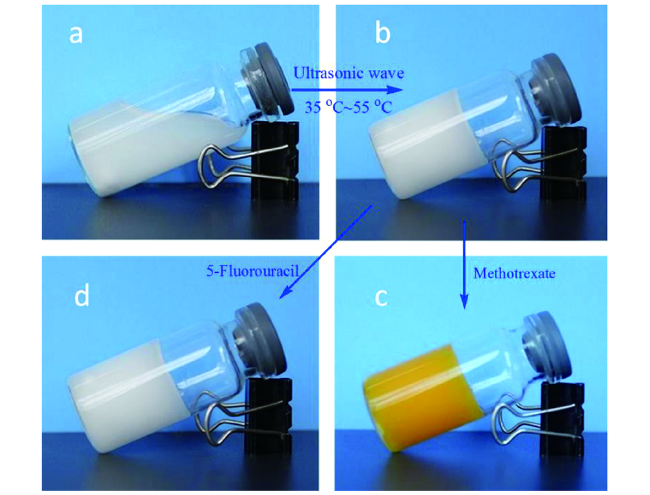
图14 凝胶转变图片:(a)β-环糊精/甘油胶体溶液;(b)β-环糊精/甘油凝胶;(c)载有甲氨蝶呤的β-环糊精/甘油凝胶;(d)载有5-氟尿嘧啶的β-环糊精/甘油凝胶[55]Fig. 14 Photographs of phase transition from(a) the colloidal solution of β-cyclodextrin/glycerol to(b) β-cyclodextrin/glycerol gel, to(c) β-cyclodextrin/glycerol gel loaded with methotrexate, and to(d) β-cyclodextrin/glycerol gel loaded with 5-fluorouracil[55] |
| [1] |
Shen Z C, Wang T Y, Liu M H . Angew. Chem. Int. Ed., 2014,53:1.
|
| [2] |
Hisamatsu Y, Banerjee S, Avinash M B, Govindaraju T, Schmuck T . Angew. Chem. Int. Ed., 2013,52:12550. https://www.ncbi.nlm.nih.gov/pubmed/24123861
DOI: 10.1002/anie.201306986 PMID: 24123861 |
| [3] |
Tam A Y, Wong K M, Yam V W . Chem. Eur. J., 2009,15:4775. https://www.ncbi.nlm.nih.gov/pubmed/19322773
DOI: 10.1002/chem.200900046 PMID: 19322773 Helical superstructures: A series of luminescent chiral alkynylplatinum(II)-terpyridyl complexes has been successfully synthesised and shown to be capable of forming metallogels that show helical fibrous nanostructures. The chiral supramolecular structure and the spectroscopic properties are found to depend on the extent of aggregation through Pt...Pt and pi-pi interactions in various counteranions, as revealed by UV/Vis, circular dichroism (CD), and luminescence studies (see picture). |
| [4] |
Ma M F, Gu J G, Yang M M, Li Z L, Lu Z Q, Zhang Y M, Xing P Y, Li S Y, Chu X X, Wang Y J, Li Q, Lin M Y, Hao A Y . RSC Adv., 2015,5:70178.
|
| [5] |
Xing P Y, Chu X X, Li S Y, Ma M F, Hao A Y . ChemPhysChem, 2014,15:2377. https://www.ncbi.nlm.nih.gov/pubmed/24789749
DOI: 10.1002/cphc.201402018 PMID: 24789749 A supramolecular gel is obtained from the self-assembly of an ultralow-molecular-weight gelator (N-fluorenyl-9-methoxycarbonyl glutamic acid) in good and poor solvents. The gelators can self-assemble into a lamellar structure, which can further form twisted fibers and nanotubes in the gel phase. Rheological studies show that the gels are robust and rigid, and are able to rapidly self-recover to a gel after being destroyed by shear force. Fluorescence experiments reveal the aggregation-induced emission effects of the gel system; the fluorescence intensity is significantly enhanced by gel formation. Graphene oxide (GO) is introduced into the system efficiently to give a hybrid material, and the interaction between gelators-GO sheets is studied. Rheological and fluorescent studies imply that the mechanical properties and the fluorescent emission of the hybrid materials can be fine-tuned by controlling the addition of GO. |
| [6] |
Xing P Y, Chu X X, Ma M F, Li S Y, Hao A Y . Chem. Asian J., 2014,9:3440. https://www.ncbi.nlm.nih.gov/pubmed/25224776
DOI: 10.1002/asia.201402645 PMID: 25224776 Self-assembly of N-fluorenyl-9-methoxycarbonyl glutamic acid (Fmoc-Glu) in water generates metastable single-wall nanotubes. These nanotubes entangle and bundle together to form unstable gels that shrink with time and finally result in lamellar crystalline precipitates. Melamine (Mm) was employed as a supramolecular modifier and stabilizer to improve the stability of the nanotubes. Mm interacts with the carboxyl-rich surfaces of the nanotubes via H-bonds and static electronic forces to diminish the high affinity of individual nanotubes and facilitate Fmoc-Glu supergelation (critical gelation concentration <0.1 wt %). Although the basic process of nanotube formation is not disturbed, Mm inverts the supramolecular helicity of nanotubes from P to M. |
| [7] |
Sui J F, Wang L H, Zhao W R, Hao J C . Chem. Commun., 2016,52:6993. https://www.ncbi.nlm.nih.gov/pubmed/27156999
DOI: 10.1039/c6cc01621a PMID: 27156999 Metal-organic gels (MOGs) of three-dimensional (3D) networks comprising nanosheets of ∼30 nm thickness and square-micrometer in size were easily produced via coordination interactions of iron (Fe(3+)) and 1,4-naphthalenedicarboxylic acid (NDC). Such MOGs exhibit ultrahigh removal of arsenic(v) in water, with the adsorption capacity of 144 mg g(-1), dramatically superior to those of the recently reported Fe-based inorganic and organic adsorbents. |
| [8] |
Song S S, Feng L, Song A X, Hao J C . J. Phys. Chem. B, 2012,116:12850. https://www.ncbi.nlm.nih.gov/pubmed/23025583
DOI: 10.1021/jp3066025 PMID: 23025583 Supramolecular hydrogels were prepared in the mixtures of a chiral amphiphilic lithocholic acid (LCA) and a nonionic surfactant, dodecyldimethylamine oxide (C(12)DMAO), in water. With the addition of LCA to C(12)DMAO micellar solutions, a transition from micelles to gels occurs at room temperature. Hydrogels can form at very low concentrations (below 0.1 wt %), exhibiting a super gelation capability. The rheological measurements show a strong mechanical strength with an elastic modulus exceeding 5000 Pa and a yield stress exceeding 100 Pa. Microstructures determined by TEM, SEM, and AFM observations demonstrate that the gels are formed by intertwined helical fibrils. The formation of fibrils is induced by enormous cycles of units composed of two LCA molecules and four C(12)DMAO molecules driven by comprehensive noncovalent interaction, especially the hydrogen bonds produced in two reversed LCA molecules and the C(12)DMAOH(+)-C(12)DMAO pairs. The xerogels show excellent adsorption capability of the toxic dye with a maximum adsorption value of 202 mg·g(-1). |
| [9] |
Nanda J, Biswas A, Adhikari B, Banerjee A . Angew. Chem. Int. Ed., 2013,52:5041. https://www.ncbi.nlm.nih.gov/pubmed/23568284
DOI: 10.1002/anie.201301128 PMID: 23568284 |
| [10] |
童林荟(Tong L H) . 环糊精化学——基础与应用 (Cyclodextrin Chemistry——Foundation and Application). 北京: 科学出版社 (Beijing: Science Press), 2001. 10.
|
| [11] |
Sun T, Li Y M, Zhang H C, Li J Y, Xin F F, Kong L, Hao A Y . Colloids Surf. A, 2011,375:87.
|
| [12] |
Sun T, Guo Q, Zhang C, Hao J C, Xing P Y, Li S Y, Hao A Y, Liu G C . Langmuir, 2012,28:8625. https://www.ncbi.nlm.nih.gov/pubmed/22607559
DOI: 10.1021/la301497t PMID: 22607559 Controlled self-assembly of amphiphilic cyclodextrin is always a challenging topic in the field of supramolecular chemistry, since it provides the spontaneous generation of well-defined aggregation with functional host sites with great potential applications in drug-carrier systems. β-Cyclodextrin modified with an anthraquinone moiety (1) was successfully synthesized. In the aqueous solution, 1 was found able to self-assemble into vesicles, which was characterized in detail by TEM, SEM, EFM, and DLS. The formation mechanism of the vesicles was suggested based on the 2D ROESY and UV-vis results, and further verified by the MD simulation. Subsequently, the stimuli response property of the vesicles, including to Cu(2+) and H(+), was also studied. The vesicles can efficiently load Paclitaxel inside the membrane with functional macrocyclic cavities available, which can further carry small molecules, such as ferrocene. The vesicles loading with Paclitaxel have remarkable anticancer effects. This work will provide new strategy in drug-carrier systems and tumor treatment methods. |
| [13] |
Sun T, Zhang H C, Kong L, Qiao H W, Li Y M, Xin F F, Hao A Y . Carbohydra. Res., 2011,346:285. https://www.ncbi.nlm.nih.gov/pubmed/21146158
DOI: 10.1016/j.carres.2010.11.003 PMID: 21146158 A modified cyclomaltoheptaose (β-cyclodextrin) containing an anthraquinone moiety, mono[6-deoxy-N-n-hexylamino-(N'-1-anthraquinone)]-β-cyclodextrin (1), which can self-assemble into nanorods in aqueous solution, was synthesized. Interestingly, upon the addition of natural cyclodextrin, the nanorods could transform into bilayer vesicles, which were characterized by transmission electron microscopy (TEM), scanning electron microscopy (SEM), dynamic light scattering (DLS), and epi-fluorescence microscopy (EFM). A transformation mechanism is suggested based on the results of (1)H NMR, 2D NMR ROESY, FTIR, and UV-vis spectra. The response of the vesicles to changing pH and adding Cu(2+) was also tested. Our research may pave the way to the development of new intelligent materials and biomaterials. |
| [14] |
Ma M F, Su J, Sheng X, Su F, Li S Y, Xing P Y, Hao A Y . J. Mol. Liq., 2014,198:1.
|
| [15] |
Zhou C C, Cheng X H, Zhao Q, Yan Y, Wang J D, Huang J B . Scientific Reports, 2014,4:7355. https://www.ncbi.nlm.nih.gov/pubmed/25483453
DOI: 10.1038/srep07355 PMID: 25483453 Xanthohumol (XN) is a natural anticancer compound that inhibits the proliferation of oestrogen receptor-α (ERα)-positive breast cancer cells. However, the precise mechanism of the antitumour effects of XN on oestrogen (E2)-dependent cell growth, and especially its direct target molecule(s), remain(s) largely unknown. Here, we focus on whether XN directly binds to the tumour suppressor protein prohibitin 2 (PHB2), forming a novel natural antitumour compound targeting the BIG3-PHB2 complex and acting as a pivotal modulator of E2/ERα signalling in breast cancer cells. XN treatment effectively prevented the BIG3-PHB2 interaction, thereby releasing PHB2 to directly bind to both nuclear- and cytoplasmic ERα. This event led to the complete suppression of the E2-signalling pathways and ERα-positive breast cancer cell growth both in vitro and in vivo, but did not suppress the growth of normal mammary epithelial cells. Our findings suggest that XN may be a promising natural compound to suppress the growth of luminal-type breast cancer. |
| [16] |
Zhou C C, Huang J B, Yan Y . Soft Matter, 2016,12:1579. https://www.ncbi.nlm.nih.gov/pubmed/26660592
DOI: 10.1039/c5sm02698a PMID: 26660592 In this work we report the chain length dependent behavior of the nonamphiphilic supramolecular building blocks based on the host-guest inclusion complexes of alkanes and β-cyclodextrins (β-CD). (1)H NMR, ESI-MS, and SAXS measurements verified that upon increasing the chain length of alkanes, the building blocks for vesicle formation changed from channel type 2alkane@2β-CD via channel type alkane@2β-CD to non-channel type 2alkane@2β-CD. FT-IR and TGA experiments indicated that hydrogen bonding is the extensive driving force for vesicle formation. It revealed that water molecules are involved in vesicle formation in the form of structural water. Upon changing the chain length, the average number of water molecules associated with per building block is about 16-21, depending on the chain length. |
| [17] |
Chen L, Chen H, Yao X Y, Ma X, Tian H . Chem-Asian J., 2015,10:2352. https://www.ncbi.nlm.nih.gov/pubmed/26211904
DOI: 10.1002/asia.201500704 PMID: 26211904 A hybrid supramolecular polymeric hydrogel is conveniently constructed via host-guest interaction of a host cyclodextrin polymer (poly-CD) with a guest α-bromonaphthalene polymer (poly-BrNp) and mixing with 6-thio-β-cyclodextrin (β-SH-CD) modified gold nanoparticles (GPCDs) in aqueous solution. According to the dynamic oscillatory data, the hydrogel exhibits markedly enhanced stiffness compared with the GPCD-free one (both G' and G" values are almost twice as high as those of the original GPCD-free hydrogel) due to the introduction of the inorganic gold nanoparticles. This hybrid supramolecular polymeric hydrogel has a rapid and excellent self-healing property (only about 1 min, and the G' and G" of the self-healed hydrogel almost turned back to their original levels after 1 hour) in air (without adding any solvent or additive). |
| [18] |
Chen H, Ma X, Wu S F, Tian H . Angew. Chem., 2014,126:14373.
|
| [19] |
Zhang Q W, Qu D H, Wu J C, Ma X, Wang Q C, Tian H . Langmuir, 2013,29:5345. https://www.ncbi.nlm.nih.gov/pubmed/23560858
DOI: 10.1021/la4012444 PMID: 23560858 Covalent or noncovalent linked polymers with stimuli-responsive properties have been well researched as a kind of advanced functional materials. However, little effort has been devoted to establishing a bridge for switching between covalent polymers and noncovalent polymers. Actually, such unitive system is promising because it can combine their chemical advantages of two types of polymers in a single and tunable platform. Herein, by taking advantage of reversible photodimerization of coumarins and host-guest assemblies with γ-cyclodextrin (γ-CD), we demonstrate a simple and effective way to construct a dual-modality supramolecular polymer, which can be switched between a noncovalent polymer and its corresponding covalent polymer in response to light stimuli. Moreover, this unique switchable polymer can also be employed to construct a dual-stimuli responsive supramolecular hydrogel with the surfactant cetyl trimethylammonium bromide (CTAB). This methodology establishes a bridge between the two "polymer mansions" and is promising to open a new class of photoswitchable materials. |
| [20] |
Nakahata M, Takashima Y, Harada A . Angew. Chem. Int. Ed., 2014,53:3617. https://www.ncbi.nlm.nih.gov/pubmed/24596338
DOI: 10.1002/anie.201310295 PMID: 24596338 The macroscopic self-assembly of polymeric hydrogels modified with β-cyclodextrin (βCD gel), ferrocene (Fc gel), and styrenesulfonic acid sodium salt (SSNa gel) was investigated. Under reductive conditions, the Fc gel selectively adhered to the βCD gel through a host-guest interaction. On the other hand, the oxidized ferrocenium (Fc(+)) gel selectively adhered to the SSNa gel through an ionic interaction under oxidative conditions. The adhesion strength was estimated by a tensile test. We finally succeeded in forming an ABC-type macroscopic assembly of all three gels through two discrete noncovalent interactions. |
| [21] |
Miyamae K, Nakahata M, Takashima Y, Harada A . Angew. Chem. Int. Ed., 2015,54:8984.
|
| [22] |
Kakuta T, Takashima Y, Sano T, Nakamura T, Kobayashi Y, Yamaguchi H, Harada A . Macromolecules, 2015,48:732.
|
| [23] |
Nakahata M, Takashima Y, Harada A . Macromol. Rapid Comm., 2015,37:86.
|
| [24] |
Zheng Y T, Kobayashi Y, Sekine T, Takashima Y, Hashidzume A, Yamaguchi H, Harada A . Nat. Commun., 2018, DOI: 10.1038/s42004-017-0003-x.
|
| [25] |
Takashima Y, Sawa Y, Iwaso K, Nakahata M, Yamaguchi H, Harada A . Macromolecules, 2017,50:3254.
|
| [26] |
Koyanagi K, Takashima Y, Yamaguchi H, Harada A . Macromolecules, 2017,50:5695.
|
| [27] |
Nakahata M, Takashima Y, Yamaguchi H, Harada A . Nat. Commun., 2011,2:511. https://www.ncbi.nlm.nih.gov/pubmed/22027591
DOI: 10.1038/ncomms1521 PMID: 22027591 Expanding the useful lifespan of materials is becoming highly desirable, and self-healing and self-repairing materials may become valuable commodities. The formation of supramolecular materials through host-guest interactions is a powerful method to create non-conventional materials. Here we report the formation of supramolecular hydrogels and their redox-responsive and self-healing properties due to host-guest interactions. We employ cyclodextrin (CD) as a host molecule because it is environmentally benign and has diverse applications. A transparent supramolecular hydrogel quickly forms upon mixing poly(acrylic acid) (pAA) possessing β-CD as a host polymer with pAA possessing ferrocene as a guest polymer. Redox stimuli induce a sol-gel phase transition in the supramolecular hydrogel and can control self-healing properties such as re-adhesion between cut surfaces. |
| [28] |
Zhang Y N, Yang D, Han J L, Zhou J, Jin Q X, Liu M H, Duan P F . Langmuir, 2018,34:5821. https://www.ncbi.nlm.nih.gov/pubmed/29672070
DOI: 10.1021/acs.langmuir.8b01035 PMID: 29672070 Soft nanomaterials with circularly polarized luminescence (CPL) have been currently attracting great interest. Here, we report a pyrene-containing π-peptide dendron hydrogel, which shows 1D and 2D nanostructures with varied CPL activities. It was found that the individual dendrons formed hydrogels in a wide pH range (3-12) and self-assembled into helices with pH-tuned pitches. Through chirality transfer, the pyrene unit could show CPL originated from both the monomer and excimer bands. When cyclodextrin was introduced, different supra-dendrons were obtained with β-cyclodextrin (PGAc@β-CD) and γ-cyclodextrin (PGAc@γ-CD) through host-guest interactions, respectively. Interestingly, the PGAc@β-CD and PGAc@γ-CD supra-dendrons self-assembled into 2D nanosheet and entangled nanofibers, respectively, showing cyclodextrin induced circularly polarized emission from both the monomer and excimer bands of the pyrene moiety. Thus, through a simple host-guest interaction, both the nanostructures and the chiroptical activities could be modulated. |
| [29] |
Li Y Y, Liu J, Du G Y, Yan H, Wang H Y, Zhang H C, An W, Zhao W J, Sun T, Xin F F, Kong L, Li Y M, Hao A Y, Hao J C . J. Phys. Chem. B, 2010,114:10321. https://www.ncbi.nlm.nih.gov/pubmed/20701367
DOI: 10.1021/jp1017373 PMID: 20701367 This paper describes the first reversible, heat-set organogel based on the supramolecular interactions of beta-cyclodextrin (beta-CD). The gel was prepared by interaction of diphenylamine (DPA) with beta-CD and lithium chloride in N,N-dimethylformamide (DMF). In this gel system, DPA could be gelated in DMF as the temperature increased and then dissolved again as the temperature decreased. In the microscopic structure of gel, beta-CDs play a key role in the formation of nanorods and microfibers. Some important features of the gel were observed. (1) The system is a multicomponent solution, in which each of the four components is required for the organogelation property. (2) The system is a reversible, thermo-responsive organogel composed of small organic molecules. When the temperature is lower than T(gel), the gel transforms back into a solution. The reversible thermo-transition was confirmed by differential scanning calorimetry (DSC). The gel system is responsive to the concentration of LiCl. No gel was formed without LiCl. The stimuli responses of the system with other salts such as KCl and NaCl were weaker than with LiCl. (4) The system is responsive to the addition of guest molecules. The structures and sizes of the guest molecules could influence the gel formation. Generally, T(gel) decreased by adding guest molecules in the gel system, but some guest molecules, whose structures are exactly fitted to the cavity of CDs, could prevent gel formation. This work may provide new avenues in delivery of functional molecules as well as design of intelligent materials and biomaterials. |
| [30] |
Li Y Y, Zhao W J, Zhang H C, Sun T, An W, Xin F F, Hao A Y . Chinese Chem. Lett., 2010,21:1251.
|
| [31] |
Zhao W J, Li Y Y, Sun T, Yan H, Hao A Y, Xin F F, Zhang H C, An W, Kong L, Li Y M . Colloids Surf. A, 2011,374:115.
|
| [32] |
Xin F F, Zhang H C, Hao B X, Sun T, Kong L, Li Y M, Hou Y H, Li S Y, Zhang Y, Hao A Y . Colloids Surf. A, 2012,410:18. https://linkinghub.elsevier.com/retrieve/pii/S0927775712003974
|
| [33] |
Xing P Y, Chu X X, Li S Y, Xin F F, Ma M F, Hao A Y . New J. Chem., 2013,37:3949. http://xlink.rsc.org/?DOI=c3nj00984j
DOI: 10.1039/c3nj00984j |
| [34] |
Li Z L, Liu W Q, Hao A Y . Colloids Surf. A, 2014,451:25. https://linkinghub.elsevier.com/retrieve/pii/S0927775714002829
|
| [35] |
Li Z L, Hao A Y, Li X . J. Mol. Liq., 2014,196:52. https://linkinghub.elsevier.com/retrieve/pii/S0167732214001263
|
| [36] |
Kong L, Xing P Y, Chu X X, Hao A Y . J. Control. Release 2017,259:e77.
|
| [37] |
Hou Y H, Xin F F, Yin M J, Kong L, Zhang H C, Sun T, Xing P Y, Hao A Y . Colloids Surf. A, 2012,414:160. https://linkinghub.elsevier.com/retrieve/pii/S0927775712005420
|
| [38] |
Xing P Y, Chu X X, Li S Y, Hou Y H, Ma M F, Yang J S, Hao A Y . RSC Adv., 2013,3:22087. http://xlink.rsc.org/?DOI=c3ra42587h
DOI: 10.1039/c3ra42587h |
| [39] |
Hou Y H, Li S Y, Sun T, Yang J S, Xing P Y, Liu W Q, Hao A Y . J. Incl. Phenom. Macrocycl. Chem. 2014,80:217. http://link.springer.com/10.1007/s10847-013-0379-x
|
| [40] |
Kong L, Sun T, Xin F F, Zhao W J, Zhang H C, Li Z L, Li Y M, Hou Y H, Li S Y, Hao A Y . Colloids Surf. A, 2011,392:156. https://linkinghub.elsevier.com/retrieve/pii/S0927775711006212
|
| [41] |
Liu W Q, Xing P Y, Xin F F, Hou Y H, Sun T, Hao J C, Hao A Y . J. Phys. Chem. B, 2012,116:13106. https://www.ncbi.nlm.nih.gov/pubmed/23051026
DOI: 10.1021/jp306462z PMID: 23051026 This paper describes a novel double phase transforming organogel (gel-sol-gel') composed of nontoxic β-cyclodextrin, potassium carbonate, and 1,2-propylene glycol. The gel-sol-gel' transforming processes are followed by a reversible gel-sol transforming process and an irreversible sol-gel' transforming process based on heating. The gel-sol-gel' transformation is accompanied by microstructure changes from nanospheres to nanorods. K(2)CO(3) plays a key role in associating supramolecular architectures of β-cyclodextrin into a three-dimensional network. This work may bring further applications in the areas of smart materials, drug delivery systems, and biomaterials. |
| [42] |
Ma X, Tian H . Acc. Chem. Res., 2014,47:1971. https://www.ncbi.nlm.nih.gov/pubmed/24669851
DOI: 10.1021/ar500033n PMID: 24669851 CONSPECTUS: Aiming to construct various novel supramolecular polymeric structures in aqueous solution beyond small supramolecular self-assembly molecules and develop functional supramolecular polymeric materials, research interest on functional supramolecular polymers has been prevailing in recent years. Supramolecular polymers are formed by bridging monomers or components together via highly directional noncovalent interactions such as hydrogen bonding, hydrophobic interaction, π-π interaction, metal-ligand coordination, electrostatic interaction, and so forth. They can be easily functionalized by employing diverse building components with specific functions besides the traditional polymeric properties, a number of which are responsive to such external stimuli as pH variance, photoirradiation, chemically or electrochemically redox with the controllable conformation or construction switching, polymerization building and rebuilding, and function adjustment reversibly owing to the reversibility of noncovalent interactions. Supramolecular polymers are "soft matters" and can be functionalized with specific properties such as morphology adjustment, controllable luminescence, shape memory, self-healing, and so forth. Supramolecular polymers constructed based on macrocycle recognition and interlocked structures represent one typical branch of the supramolecular polymer family. Cyclodextrin (CD), cucurbituril (CB), and hydrophilic calixarene derivatives are usually employed to construct hydrophilic supramolecular polymers in aqueous solution. Stimuli-responsive hydrophilic supramolecular polymers, constructed in aqueous solution particularly, can be promising candidates for mimicking biocompatible or vital functional materials. This Account mainly focuses on the recent stimuli-responsive supramolecular polymers based on the host-guest interaction in aqueous solution. We describe the hydrophilic supramolecular polymers constructed via hydrophobic effects, electrostatic interaction, metal-ligand coordination, and multiple combinations of the above noncovalent interactions. The disparate ways to engender stimuli-responsive supramolecular polymers via the hydrophobic effects of α-CD, β-CD, and γ-CD macrocycles are illustrated and discussed. Some recent works on CD-based photoresponsive functional supramolecular polymers are summarized. CB (especially CB[8]) based supramolecular polymers and their pH-responsive and photoresponsive properties are introduced. Hydrophilic calixarene derivative (bis(p-sulfonatocalix[4]arene) typically) based supramolecular polymers via electrostatic interactions are reviewed, and their redox-responsive association/disassociation elaborated in detail. More complicate supramolecular polymers based on multiple noncovalent interactions are illustrated including hydrophobic effect, metal-ligand coordination, and electrostatic interactions and their functional stimuli-responsiveness elaborated as well. Finally, we give perspectives on the strength of these diverse noncovalent interactions to form supramolecular polymers in aqueous solution, on the advantage, disadvantage, efficiency, and reversibility of using certain stimuli in constructing supramolecular polymers and prospect the future function improvement of these polymers as functional materials. |
| [43] |
Qu D H, Wang Q C, Ren J, Tian H . Org. Lett., 2004,6:2085. https://www.ncbi.nlm.nih.gov/pubmed/15200291
DOI: 10.1021/ol049605g PMID: 15200291 [reaction: see text] A molecular shuttle containing an alpha-CD macrocycle, an azobenzene unit, and two different fluorescent naphthalimide units was synthesized. The cis-trans photoisomerization of the azobenzene unit resulted in the motion of the CD macrocycle on the track. Because of the easy regulation and full reversibility of the fluorescence change of the two stopper units, the molecular shuttle could be used as a molecular storage medium or switch with all-optical inputs and outputs. |
| [44] |
Li Y G, Liu M . H. J. Colloid Interf. Sci., 2007,306:386. https://www.ncbi.nlm.nih.gov/pubmed/17140595
DOI: 10.1016/j.jcis.2006.10.055 PMID: 17140595 4-(N-Stearoylamino)-2-amino-azobenzene (AzoNH2C18) and 4-(N-stearoylamino)-azobenzene (AzoC18) have been synthesized. The inclusion complex formation of AzoNH2C18 and beta-cyclodextrin (beta-CyD) at the air/water interface was investigated and compared to that of AzoC18. It has been found that both the amphiphiles can form stable monolayer films on water surface. When the amphiphiles were spread on the aqueous solution of beta-CyD, AzoNH2C18 can form inclusion complexes with the beta-CyD molecules at the interface while AzoC18 cannot. The inclusion complex formation was confirmed by the changes in the isotherms and the circular dichroism (CD) and Fourier transform infrared (FT-IR) spectra of the transferred LS films. Atomic force microscopy (AFM) observation found morphological changes in the course of complex formation. It was suggested that the additional amino group in the azobenzene ring plays an important role in forming the inclusion complex in situ at the air/water interface. |
| [45] |
Ma X, Cao J J, Wang Q C, Tian H . Chem. Commun., 2011,47:3559. https://www.ncbi.nlm.nih.gov/pubmed/21321705
DOI: 10.1039/c0cc05488g PMID: 21321705 Photocontrolled reversible room temperature phosphorescence (RTP) emission engendered by the complexation of β-cyclodextrin (β-CD) and α-bromonaphthalene (α-BrNp) can be employed to address the threading and dethreading of the pseudorotaxane formed between β-CD and sodium 2-hydroxy-5-((4-nitrophenyl)diazenyl)benzoate (DAYR) in the ternary system in aqueous solution. |
| [46] |
Xing P Y, Sun T, Li S Y, Hao A Y, Su J, Hou Y H . Colloids Surf. A, 2013,421:44.
|
| [47] |
Hou Y H, Sun T, Xin F F, Xing P Y, Li S Y, Hao A Y . J. Incl. Phenom. Macrocycl. Chem., 2014,79:133.
|
| [48] |
Chu X X, Xing P Y, Li S Y, Ma M F, Hao A Y . Colloids Surf. A, 2014,461:11. https://linkinghub.elsevier.com/retrieve/pii/S0927775714006347
|
| [49] |
Saenger W, Jacob J, Gessler K, Steiner T, Hoffmann D, Sanbe H, Koizumi K, Smith S M, Takaha T . Chem. Rev., 1998,5:1787.
|
| [50] |
Xin F F, Xing P Y, Li S Y, Hou Y H, Hao A Y . RSC Adv., 2013,3:21959. http://xlink.rsc.org/?DOI=c3ra43242d
DOI: 10.1039/c3ra43242d |
| [51] |
Chen Y, Zhang Y M, Liu Y . Chem. Commun., 2010,46:5622. https://www.ncbi.nlm.nih.gov/pubmed/20585706
DOI: 10.1039/c0cc00690d PMID: 20585706 Possessing a hydrophobic cavity that can bind various organic, inorganic or biological molecules, cyclodextrins (CDs), a class of cyclic oligosaccharides with six to eight D-glucose units, are widely used as convenient and versatile building blocks in the construction of multidimensional nanoarchitectures. Through the self-assembly of CDs or their derivatives with or without templates, several kinds of CD-based one-dimensional or multidimensional nanoarchitectures, such as helix, pseudopolyrataxane, polyrotaxane, nanotube, nanowire, dendrimer, network, vesicle, nanoparticle, CD-coated carbon nanotube, and so on, can be successfully constructed via the cooperative binding of CD cavities, substituent groups, and/or template molecules. This article describes some strategies normally used to construct and characterize one-dimensional or multidimensional nanoarchitectures in solution and the solid state from various CDs and templates as building blocks. It also gives a description of the unique material and biological properties and wide applications of multidimensional CD-based nanoarchitectures. |
| [52] |
Gao Y A, Zhao X Y, Dong B, Zheng L Q, Li N, Zhang S H . J. Phys. Chem. B, 2006,110:8576. https://pubs.acs.org/doi/10.1021/jp057478f
DOI: 10.1021/jp057478f |
| [53] |
Li Z L, Hao A Y, Hao J C . Colloids Surf. A, 2014,441:8. https://linkinghub.elsevier.com/retrieve/pii/S0927775713006894
|
| [54] |
Xing P Y, Li S Y, Xin F F, Hou Y H, Hao A Y, Sun T, Su J . Carbohydra. Res., 2016,367:18. https://www.ncbi.nlm.nih.gov/pubmed/23291275
DOI: 10.1016/j.carres.2012.11.023 PMID: 23291275 A multi-responsive cyclodextrin-based organogel with a crystalline-like structure is first reported. An amount of β-cyclodextrin (β-CD) and lithium chloride (LiCl) was added into N,N-dimethylformamide (DMF), and the system obtained could transform instantly from a transparent solution into a gel state by introducing ethylene diamine (EDA), and then the gel could turn into another precipitate-like gel by undergoing a heating-cooling process. Among a series of aliphatic amines, only EDA was found to be able to induce the gel formation. Both the gels possess crystalline-like structures in their morphology with sheet-like layers, in a highly-ordered channel-type packing mode, which were proved by OM, SEM, XRD, and FT-IR measurements. Furthermore, the gel could respond to H(+) and Cu(2+) by transforming into an amorphous precipitate. This research may pave the way for the design of novel smart materials. |
| [55] |
Li Z L, Zhang B, Jia S H, Ma M F, Hao J C . J. Mol. Liq., 2018,250:19. https://linkinghub.elsevier.com/retrieve/pii/S0167732217353813
|
| [56] |
Kong L, Zhang F, Xing P Y, Chu X X, Hao A Y . Colloids Surf. A, 2017,522:577. https://linkinghub.elsevier.com/retrieve/pii/S0927775717302510
|
/
| 〈 |
|
〉 |